
Evaluating Group Health Insurance Broker Bids in Alaska: A Guide to Making the Process Painless
For business owners, evaluating group health insurance broker bids is grueling. There’s no playbook, and few people know what to look for or how the process works. The stakes are high. Choosing the wrong broker or overlooking important differences between plans can have a significant impact on your company’s healthcare costs and compliance throughout the year.
So, how do you find a broker you can trust and make an informed decision? Here’s what every business owner should know.
Start With Recommendations, Not Proposals
One of the best ways to find a reliable insurance broker is through personal recommendations. Ask other business owners about their experiences, talk to your friends and colleagues, and don’t be afraid to ask about situations where things didn’t go as planned. You can also contact your state’s Department of Insurance to check whether a broker has a history of complaints.
Why does this matter? People who have worked with a broker can give you more insight into how that broker handles renewals or advocates for clients when challenges arise.
“You want to find out how they handle things under pressure,” says Rebecca Yates, CEO of Ark Insurance Solutions. “Recommendations from within your personal circle are a great place to start.”
Understand Whether You Need Multiple Bids
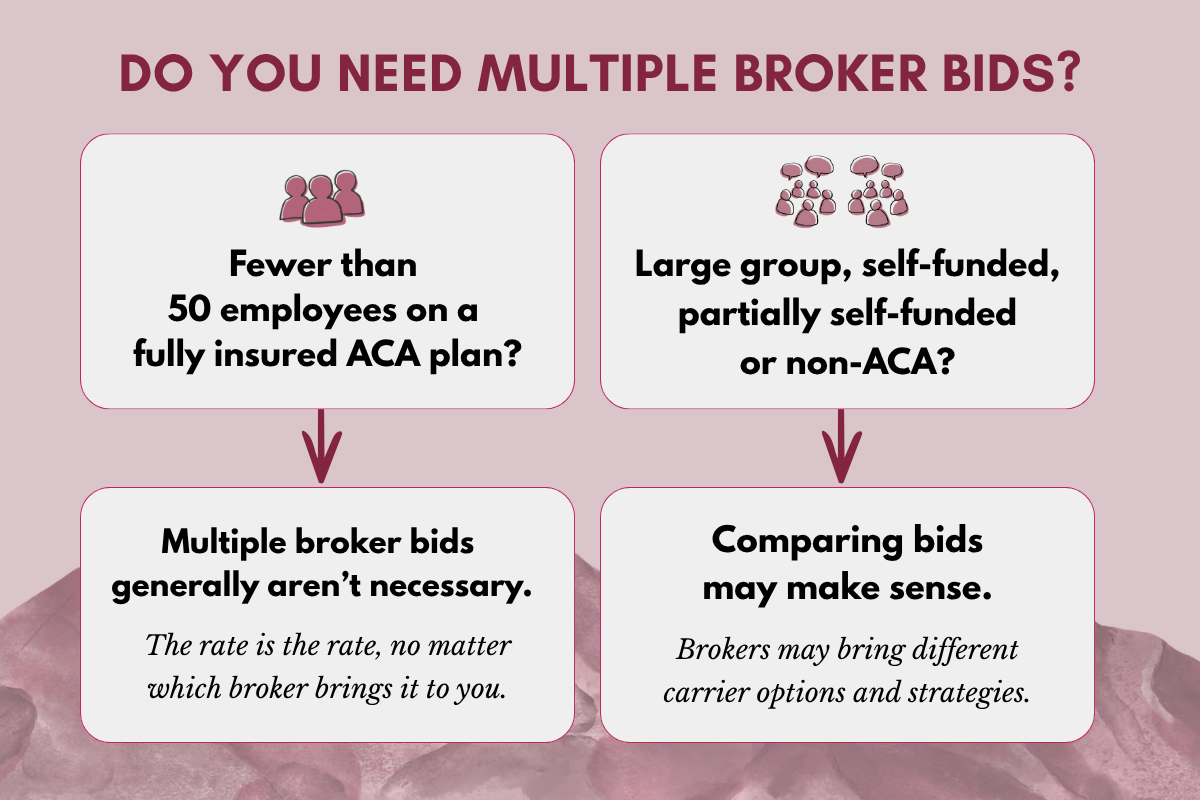
Not every business needs to collect multiple insurance bids.
If your company has fewer than 50 employees and is enrolled in a fully insured ACA-compliant plan, then you don’t need multiple bids. These plans are guaranteed-issue and community-rated, meaning every broker has access to the same carrier rates for that plan type.
“This is why you’re going to want to find your broker first, then do the bidding. They can help guide you based on your number of employees,” Yates explains.
Multiple bids become more valuable when your company is considering partially self-funded or self-funded coverage, non-ACA plans, or insurance options for larger groups.
Make Sure Your Bids Compare Apples to Apples
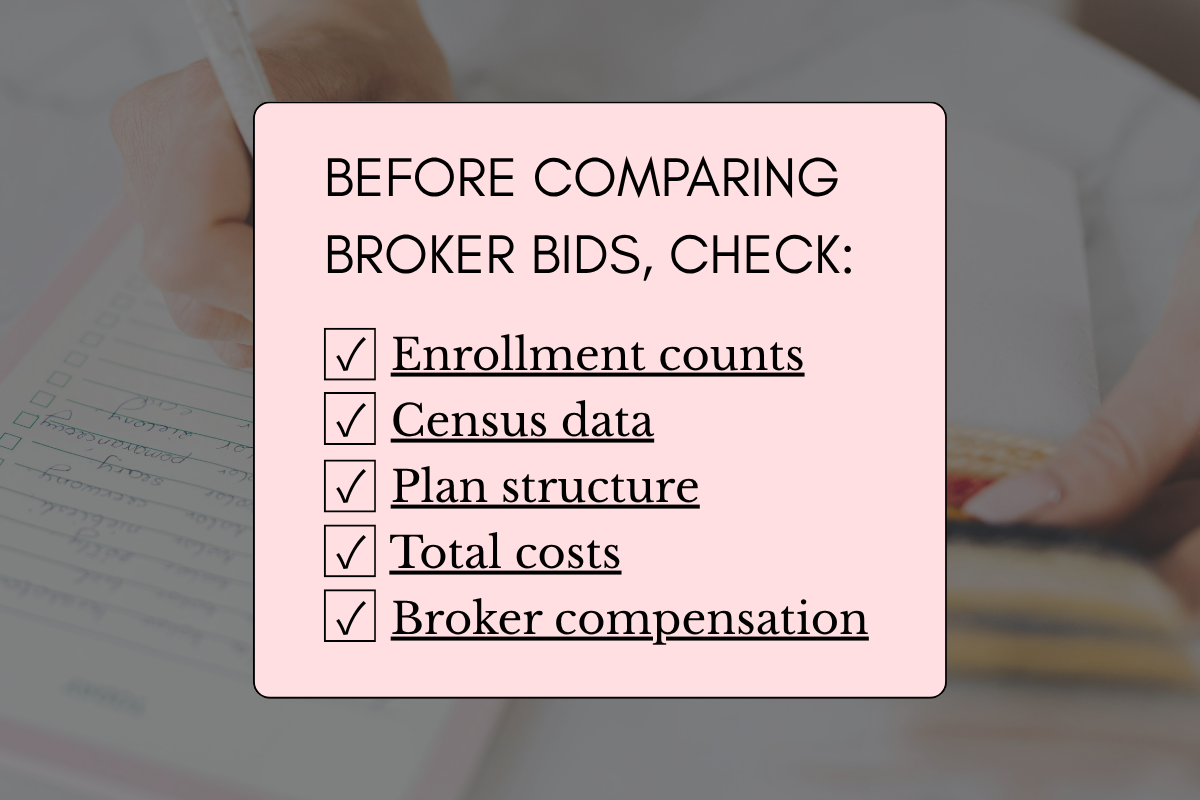
Insurance bids aren’t always based on identical information. Differences in employee census data, enrollment assumptions, or simple data-entry errors can lead to discrepancies between carrier proposals. If you don’t catch those differences, you may end up comparing prices that don’t accurately reflect the same group.
“I can take one census and send it to every single insurance carrier, and they’ll all come back with a different count,” Yates says. “It doesn’t matter that I’m sending them all the same census data on the number of people enrolling. Oftentimes, none of them match.”
An experienced broker should help verify employee counts and enrollment figures across every proposal. Making sure each carrier is working from consistent information gives you a much more reliable basis for comparing costs and coverage.
Understand How Your Broker Gets Paid
Pricing isn’t the only area that deserves a closer look. You should also understand how your broker is compensated. Brokers can get paid in several ways—through a per-member-per-month fee, carrier overrides, broker fees, reinsurance fees, network fees, and sometimes even trips or bonuses. These arrangements aren’t automatically a problem, but transparency is essential.
If a broker receives additional compensation for recommending a one carrier over another, that arrangement could create a conflict of interest. You deserve to know whether any financial incentives are influencing your broker’s recommendations.
Brokers are subject to legal compensation disclosure requirements, so ask for a clear explanation of how your broker is paid and what fees or incentives apply. If that information isn’t provided upfront, ask for it.
Give Yourself Enough Time to Get It Right
Timing can have a significant impact on your insurance options. If you move too slowly through the bid process, the rate you were quoted may no longer be available by the time you’re ready to sign.
For a relatively straightforward bid and implementation process, plan for approximately three to four months. Larger groups should consider allowing six months or more, since underwriting and evaluating more complex groups can take considerably longer.
The challenge is that carriers typically release renewal rates on relatively short timelines. Small groups may receive only about 60 days to decide. Timelines for other groups can be even tighter. Starting the process early gives you more time to review proposals, ask questions, and make an informed decision.
Keep in mind that your final premium may also differ from the original bid. For groups outside the small, fully insured ACA market, underwriters may reassess the group based on actual enrollment rather than initial projections.
For example, a company might submit an employee census anticipating 20 enrollees but ultimately have only 16 people sign up. Depending on the plan and underwriting arrangement, that change could affect the final rate, causing it to increase or decrease from the original proposal.
These adjustments aren’t necessarily the result of a broker making a mistake. They can reflect changes in enrollment and the underwriting process itself.
A Good Broker Shows You Every Bid
Does your broker show you every bid they received, or just the ones that make their recommendation look best? It’s an important question to ask.
“I always show my clients all of the bids we received. Not every broker does that, but I want you to be able to see that we went to the whole market,” Yates says.
Seeing every bid, including the more expensive ones, is how you confirm nobody’s thumb is on the scale. A broker with real experience can tell you which plan really fits your company’s needs, not just which one is cheapest.
Remember, You Can Change Brokers At Any Time
Most business owners think they’re stuck with their broker until renewal. But they’re not. You can generally change brokers without changing your existing health insurance plan. The process typically involves signing an Agent of Record (sometimes called an “AOR”) letter, which authorizes the new broker to represent your company with the carrier.
Carriers build in a five-day waiting period before the switch takes effect. That delay exists for an important reason. It gives your current broker a chance to confirm the switch is legitimate before it goes through. They cannot block the switch—but it does give them a few days to raise a flag if they truly believe the change wasn’t authorized.
It’s OK to Get A Second Opinion
You don’t have to replace your current broker to get another perspective on the proposals you’ve received.
Ark Insurance Solutions offers licensed consultants who can review existing insurance bids for an hourly fee, without participating in the bidding process themselves. This provides an opportunity to get an independent assessment without tying the consultant’s compensation to which plan you ultimately select.
Because the consultant isn’t earning a commission based on the outcome, the review can offer an additional layer of objectivity.
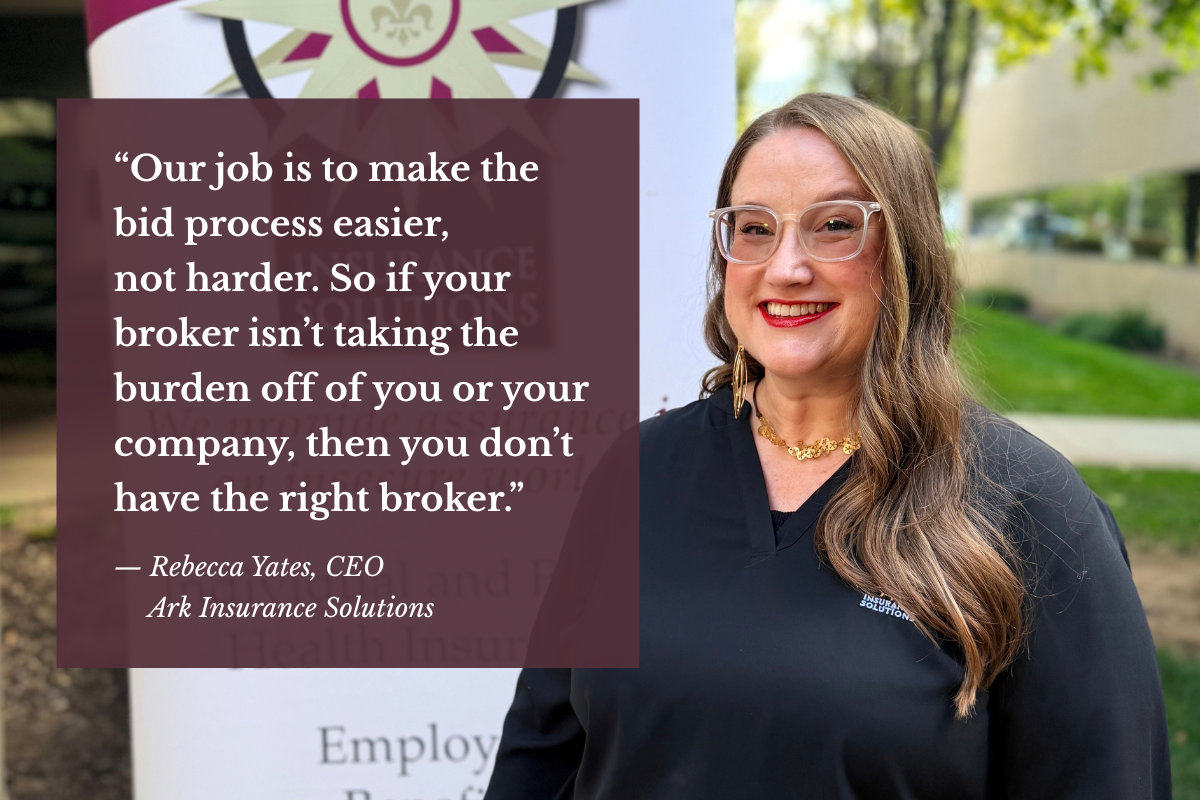
“Because I’m not the broker bidding on any of it, I don’t have a hat in the game,” Yates says. “We can be the honesty police and let you know if something is off.”
An independent review can help you identify discrepancies, understand differences between proposals, and determine whether the recommendations you’ve received make sense for your business.
Ark Insurance Solutions can help you make sense of your options.
If you’re heading into a bid process for the first time, or if you’re sitting on bids right now and aren’t sure what you’re looking at, Ark can help. Give us a call at 907-318-1092 or click here to schedule an appointment today.


